Tuesday, July 19, 2011

Proyectos Lindos (Pretty Projects)

If there is one thing that all PC Paraguay volunteers can agree on it’s that all Paraguayans want to do a project that sounds “lindo” (pretty). Por ejemplo:
-          Reading books to the class = not so lindo
-          Painting murals in front of the school = Soooo lindo
So, what to do, what to do…? Obviously teaching the value of books is important, but if I ever want to get to the point of convincing my school to do a big project with books, I must do something lindo first.
For my first very lindo project, I have decided to collaborate with another Encarnación volunteer (Jessica) to paint murals in celebration of “El Día de la Juventud” (The Day of the Youth). My school (Dr. Francia) and another school, which I plan to begin working at in the near future, have both expressed interest in participating. We are also planning on asking another school in the area and perhaps the youth group of the Baptist Church (yes, there is a Baptist Church in Encarnación). I would have liked to have painted a mural with the girls at the orphanage, but the orphanage director insisted that they didn’t have a “lindo” place to paint one. I was and still am disappointed about that because the orphanage has the most space of all of the potentially interested organizations to paint a mural.
Where to begin??
 Jessica and I have met a few times in order to go over the details of the project. We have identified the whos, whats, whens, wheres and hows of the project. Check it out:
Who: Any school or organization in Encarnación that has youth from the ages of 13 – 18.
What: Each organization will choose a theme (friendship, environment, values, etc.) and then ask its jovenes (youth) to draw potential designs for a mural. The leaders of the organization will then choose a few of the drawings to use. In addition to painting murals, the project will also promote teamwork, creativity, civic service (making your community beautiful), responsibility, self-esteem and pride in one’s work, school, community and self.
When: Late August – September 2011
Where: Schools, organizations, youth groups
How: Schools and organizations will provide ladders, buckets, cloths, paint brushes and paint thinner. We are in the process of writing a “pedido” (request) to City Hall for the money to buy the paint, which is the most expensive supply.  After checking around on prices, I discovered that paint brushes and paint thinner are very inexpensive, and I am assuming that the majority of the organizations already have ladders and buckets.

I drew up the letter for the City Hall this week, and we plan to meet with the principals of the schools and whoever else late next week to get their signatures showing their involvement. Then the letter will be off to City Hall and hopefully, APPROVED! Fingers crossed!

Thursday, July 14, 2011

Updates and New Perspectives.

When I meet new people they never fail to ask me the infamous question “Why did you join the Peace Corps?” And in all honesty, I do not blame them for asking. I think that each PC volunteer joins for different reasons. Maybe at first many of us have a few common goals such as helping people, giving back, seeking adventure and/or breaking-out of the norm, but after a few months in, I believe that the answer to the question changes. Clearly you join because of one reason, but you decide to stay based on so many others. So, why did I join the Peace Corps?
I joined the Peace Corps because
-          Volunteering has always been a part of my life.
-          I have always enjoyed traveling.
-          I find foreign languages intriguing.
-          Helping others is one of the best feelings in the world.
Now that that is clear, let us move on to the next hanging question…Once PC volunteers actually arrive in their assigned country, and they may discover that their job is not at all glamorous, life will be lonely at times, difficulties will be more frequent than expected, etc., por qué se continuan a trabajar para el Cuerpo de Paz (why do they continue to work for the Peace Corps)? I cannot answer for anyone else but myself. Why am I still a Peace Corps volunteer?
I am still a Peace Corps volunteer because
-          I am a problem-solver. I believe that I have always had a knack for identifying problems and leading the way to finding a solution. PC volunteers encounter problematic situations everyday which they might be asked to help solucionar (to solve). I find this part of the job very rewarding. Most people my age in Paraguay are in a different stage of their lives. They are either in college or they are raising a family. Most are not already professionals in their fields of study at age 23, so if I want respect I must demand it. When I bring a solution to the table, I can feel the respect and admiration of my peers.
-          I want to help open the minds of others. Whenever I see an opportunity to throw in a lesson on negative stereotypes, taking care of the world, working towards your dreams, sharing and helping others, etc. I. Do. It. You do not have to wait for a formal classroom lecture to teach others life lessons. As soon as I see something happen, i.e. a student throws his/her trash on the ground, I jump right in not to give a lecture, but to help he/she discover a new outlook on the current situation.   
-          I like seeing my students ENJOY school. When I walk into the classrooms the students get excited. They all know that for the next 40 minutes or so that they will not have to copy from the board.

Next a few updates.
We are currently on “winter break” here until the end of next week. Interestingly enough, the actual cold weather has seemed to disappear and in its place we are experiencing warm, pleasant days. Trust me, I am not complaining. When you live in a concrete block building, you cannot wait for the days of primavera (spring). Sadly, it is rumored that the cold weather will resurface, but I am going to keep my fingers crossed that it doesn’t.
So, no classes for two weeks, but I am still relatively busy going to the orphanage, making materials, planning for future projects and visiting my newest workplace Color de Esperanza. For the purposes of this blog, I will refer to Color de Esperanza as CE. CE is an organization that was created with the help of the city hall to keep children off the streets of Encarnación. The organization is housed in a small building with two classrooms, bathrooms, kitchen and office. Color de Esperanza is similar to a “comedor”, which is a place where children can go eat for free; however, unlike a “comedor”, it has other services as well. In addition to eating, children can also bathe, wash their clothing and participate in classroom activities.
Seems like a pretty good organization right? Yes, it is; however, the children are a handful. Before going to CE, I had spoken to another PC volunteer that had previously worked there giving charlas (talks) on health and playing with the children. She told me that she stopped going because of the lack of respect from both the adults and the children at the program. I try to not let other volunteers’ experiences shape my attitude, but I definitely know to what she was referring.
Let me give a few examples from today’s session as CE:
-          Almost of the children cheated in the game we played together even though I asked them over and over not too.
-          There were multiple boxing matches between children.
-          No one wanted to share.
Now that I have had a few minutes to reflect, I have been able to draw a few conclusions from today.
1.       I do not work at the school of these children, so they did not know me prior to today. It is harder for them to see me as their teacher because they do not see me in a formal classroom setting.
2.       These children have extremely rough home lives. If no one is monitoring whether or not they are eating or bathing, then I guess I can understand why they are a little rough around the edges.
3.       They do not have any of the games that I brought and/or any game at all, so naturally “sharing” is not the first thing that comes to mind.
Entonces, what do I plan to do?
1.       I am going to set rules in place and enforce them. Although I mentioned today that those who didn’t behave well would not play with the group in the future, I do not believe that anyone took me seriously.
2.       I may seek out the school that the children of CE attend to see if I can get some face time there. The girls at the orphanage behave so well because I teach in their classes. They see me as their authority figure and friend.  
3.       Try, try and try again.

And now the phrase that can be used in almost all contexts: Vamos a ver…verdad?

Monday, June 27, 2011

Oops.

Wow, has a month really passed since my previous post? Things have been busy, yet I guess nothing too newsworthy has occurred. Poco-a-poco, I am developing my ideas and potential strategies on how to go about making the most affective action plan for my community, entonces  just want to let you know that I haven’t forgot about this blog.

Monday, May 30, 2011

Un Techo Para Mi Pais.

A few weeks ago I read an article in Ultima Hora (a Paraguayan newspaper) about an organization called Un Techo Para Mi Pais. I learned from the article that Un Techo Para Mi Pais is an organization that recruits volunteers to build houses for families-in-need around the nation. Sound familiar? Yes, it is the Latin American version of Habitat for Humanity. The families are chosen based on who has the greatest need and who can complete the requirements. The families must complete a course - financial maybe? It didn't say.. - and contribute 300,000 Guaranis (about $75 US Dollars) to their new home.

If you have worked with Habitat before you will know that before the volunteers begin with the construction the foundation is set-down and then a team of people trained in electricity and other areas and volunteers set to work (generally for about a week). In Habitat, the team builds the house, puts in counters and cabinets, completes a bathroom, paints each room, etc. It is quite the production. In Un Techo, the houses are much more basic. When I say basic, I mean we used pre-fabricated walls that had holes in them, wood posts and rocks for the foundation and sheets of metal for the roof.

Both organizations are based on giving families-in-need a basic and a humane place to live. Humane is different from country-to-country. Because the standard of living is lower in Paraguay, the homes that the organization builds are not the same as they would be in the U.S. Still it is amazing to see the reaction of the people that receive this humble home. The family (of 6 people) for who we built the house was living in a "house" that had plastic covering holes in the ceiling and walls. The floors were dirt. The first room had a stove and a cabinets and the second room had three beds.

I would have to say that I was not surprised by the poverty. I had previously seen homes in these conditions in Costa Rica and Panama. However, even before I saw those homes, I knew that this kind of poverty existed in the world. The other volunteers that I worked with were local Paraguayan university students. Obviously, they were from a different financial situation than their fellow Paraguayans. AND even though we live 20 minutes from this area, many of these Paraguayans did not know that poverty like this existed in their area.
So my question is...how can you get through high school and years of college and not know that extreme poverty exists? That it exists in your area? Although I know that I am being hard on them, I was completely annoyed when a few people cried and said they did not know that people lived that way...How can you be in your late-teens or early 20s and not know that? Por lo menos (at least) they now better understand the realities of the world, but understanding is not enough. If we all truly believe that poverty is a cruel thing, then we must do something more to combat it. Building a few houses and then leaving the community will not solve the bigger problems. Yes, it is great that 20 families in the state of Itapua received better homes this weekend, but what are we doing to make sure that others do not fall into this same type of situation. I hope to help others realize that one weekend's worth of work is not enough. I want to encourage more young Paraguayans to get involved in the lives of other Paraguayans to help them better develop and live better lives. The reality of it all is that I will have two years to do all that I can, but in the end, it is up to Paraguayans to change Paraguay.

I know that the majority of my work in the Peace Corps must be done in my personal community, but I plan to return to that community as well to do whatever little that I can...Camps for children? Talks on health? Workshops with teachers? We will see.


Volunteers carrying supplies to their worksites. We only had two guys in our group so I had to partake in the heavy lifting. And you better believe that I feel it today.


The then current home of our family.

The bathroom. It actually has a flushing toliet, but there is no ceiling. Also, there is a pipe for a shower in this area. There is no floor so they put down a piece of wood to stand on while they shower.


Unloading the wood that we used as the foundation.


Digging the holes for the posts. The ground was so hard.


I crushed rocks with Melissa and her brother for 3 hours. They loved wearing our work gloves!


This is where the mother of the house washes the family's clothes.


The black on the posts is oil. It is supposed to help preserve the wood.


The end of our first day of work.


Melissa wanted to take a picture of me.


Day 2. FINALLY the floor is down! The foundation was the hardest part.


 I held up the wall as another volunteer hammered.


Nailing the walls together was probably the fastest part.


The mother of the house! Almost done!


Putting the insulation.


We ate some greaaattt sopa (a type of bread similiar to cornbread) from this oven.


La vista (the view) from their new home!

Monday, May 16, 2011

Happy 200th Birthday Paraguay.

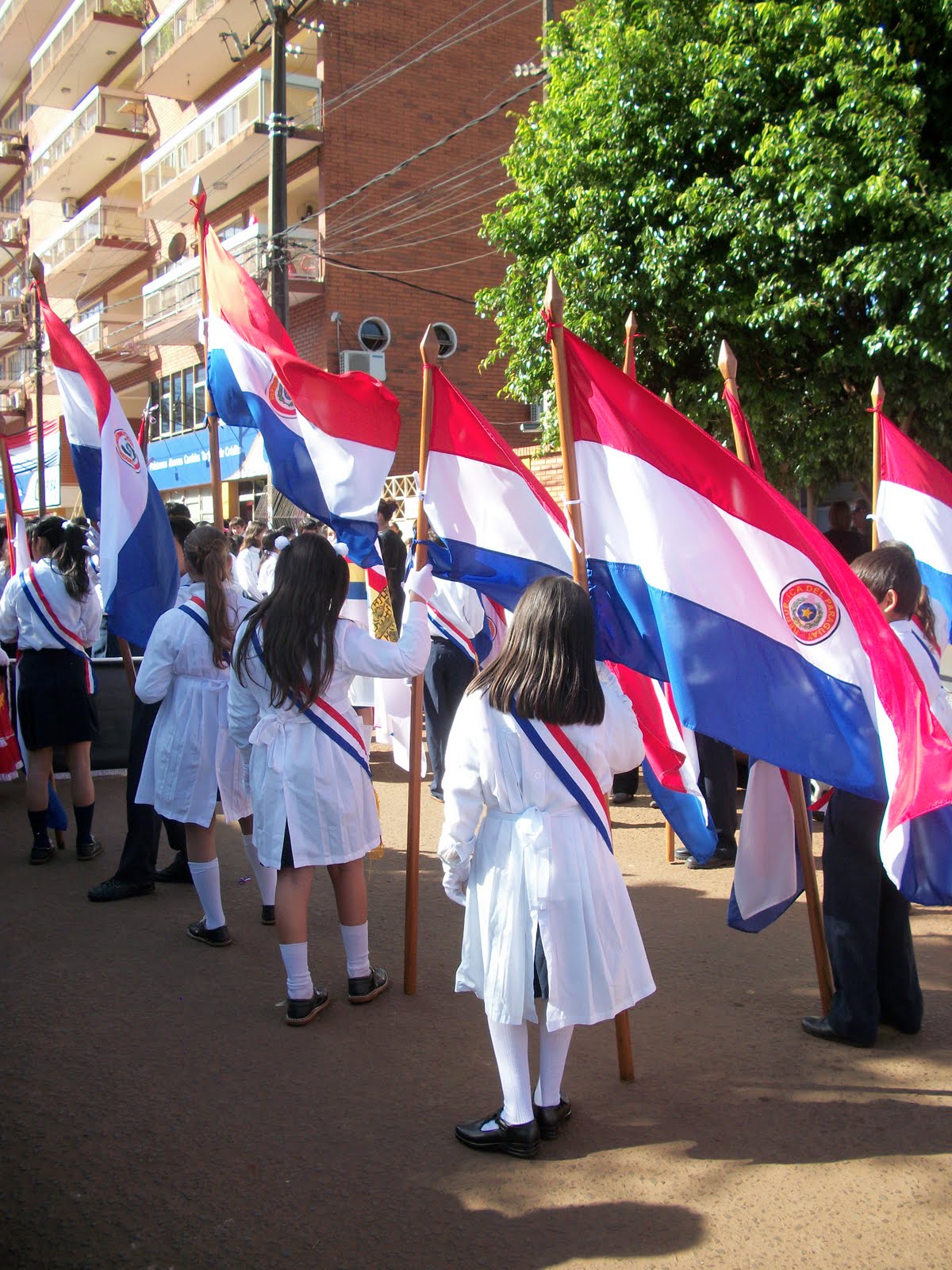
This year Paraguay (among other countries in South America) is celebrating 200 years of independence from Spain. It is obvious on every street corner. If there is not a flag, someone is wearing a pin of flag. If there is not an event in the plaza, the school is having a performance. Everyone seems to be very excited about this historical moment, and I hope their excitement continues. I believe that it is an ideal time for a Peace Corps volunteer to be in Paraguay. We should all use this renewed pride to spread ideas such as taking care of the environment, being proud of yourself, doing something to better your community/country, leading others to do positive things, etc.
Today I walked in the Bicentenario parade with my school. After practicing for a month, I believe that the students did an excellent job. I was very proud to walk with them.


Paulita.


Beginning to walk...(after a 2 hour wait).


My School.


The Plaza de las Armas.

Friday, April 29, 2011

Taking a Little, Yet Doing A Lot

Remember those simple card games you loved as a child? The ones you played over and over and over again? Old Maid, Memory, Go Fish...? Today I had the opportunity to introduce 10 little girls to these fun games. 

Seeing as school was cancelled today in celebration of "El Dia del Maestro" (The Day of the Teacher), I had some extra time on my hands. I decided that it was a perfect time to make good on my promise, so I returned to the girls' orphanage to pay them a visit. Upon entering into the home, I found the girls doing their homework and/or working on the small crafts that they sell for a little spending money. The orphanage’s Directora told the girls to pack up their notebooks and materials, and we headed upstairs to their "library". As I began to stumble through the games' instructions, I realized that I should have prepared a little bit before coming. I guess I did not think about how I would need to know the verb for "flip over" (dar la vuelta a), "deal" (repartir), etc., but thankfully the girls were very patient and after a few examples, they were playing like pros. We first played Memory all together with the homemade deck of cards that I had made out of cardboard, markers and contact paper. I told them that I was not an artist, so they would have to bear with me on the crazy little pictures that I had drawn. However, we all still had a good laugh over some of the drawings. Afterwards, we split-up into 3 groups and each group played a different game.

When I was leaving, the Directora of the orphanage asked if we could establish specific times for me to come and play/work with the girls. So, as of now I will be spending Monday afternoons with the girls that go to school during the morning shift, and I will be there on Wednesday mornings to visit with the girls that attend school in the afternoons. (Did I explain this previously? Children only go to school either for 4 hours in the morning or 4 hours in the afternoon.)

My current plan is to get to know the girls during the upcoming weeks and then possibly begin to insert self-esteem, health and other lessons into our time together. I have spent the rest of the afternoon thinking about all of the other games I loved as a child and how I cannot wait to share them with my newest friends!

P.S. Did I mention that they call me Tia (Aunt)??

Thursday, April 28, 2011

Just Call Me the Miracle Worker.

Today's workload was relatively light. I got up at 8 am (versus 6 am), got ready, had some coffee and walked over to the House of English. There I met with the two owners of the language school, and we came to the agreement that I would teach a group of 5 teenagers on Tuesdays and Thursdays in the afternoon. I returned to my house for a short lunch break and then I downloaded a few free Spanish podcasts on ITunes. At about 2 pm I walked the short two blocks to my school with the intentions of observing a few classes. HOWEVER little did I know, I would be doing much more.

Without revealing too much information, I will recount the afternoon events.

I went into the Directora's office to talk to her about the lesson that we will be co-teaching together on Monday (over parental-roles, costs and work related to having a child, etc). After I brief discussion about other things (getting straight to the point is not a part of the culture), a parent entered the room. I immediately saw from the parent's facial expressions that I did NOT want to be a part of the up-coming conversation. I quickly tried to dismiss myself by saying, "Bueno, nos vemos el lunes", but the Directora was not having it. She politely, yet sternly asked me to stay. I sat.

Let's just say that by the end of the conversation (in which I did not participate), the Directora had promised this parent (actually grandparent acting as parent) that I was a specialist from the United States that would counsel her and her 4 -year-old, violent grandson. When the woman left the room, I was unsure of what I had heard. I thought to myself, “I must of heard wrong. I did not understand the words correctly. I must of spaced-out.” Yet, I had heard correctly. On Monday, I will be acting as guidance counselor. Did they cover that in Public Relations 400?

On a different note, here is a picture of me before my swear-in ceremony.


Thanks for the job JFK.

P.S. In general, Paraguays LOVE JFK. There is a neighborhood and a school named after him about 20 minutes from where I live.